Expected value (EV) is what a bet makes or loses on average if you placed it many times at the same price and the same chance. The formula is one line:
EV = (chance of winning x profit if it wins) - (chance of losing x stake)
A $100 bet at -115 pays $86.96 profit. If the over really hits 56% of the time, EV = 0.56 x $86.96 - 0.44 x $100 = +$4.70. Positive EV is a bet worth making; negative EV is a donation, however good it feels. The whole difficulty is the one number you have to supply: the chance.
The formula in three forms
All three say the same thing; use whichever matches the odds you're looking at.
- Dollars: EV = p x profit - (1 - p) x stake.
- Per dollar, with decimal odds: EV = p x decimal odds - 1. At -115 (1.870) and 56%: 0.56 x 1.870 - 1 = +4.7%.
- Against the break-even: a bet is +EV exactly when your chance is above the chance the price implies. -115 implies 53.5%, so anything above 53.5% is +EV, anything below is -EV.
| Price | Decimal | Break-even chance | EV a $100 at 55% |
|---|---|---|---|
| -130 | 1.769 | 56.5% | -$2.69 |
| -115 | 1.870 | 53.5% | +$2.83 |
| -110 | 1.909 | 52.4% | +$5.00 |
| +100 | 2.000 | 50.0% | +$10.00 |
| +110 | 2.100 | 47.6% | +$15.50 |
Where the chance comes from
EV is only as good as the chance you put in. There are two honest sources.
The market without the vig. Take both sides of a sharp book's line and scale their implied chances down to 100%. At -105 / -115 the over's fair chance is 48.9%. If another book offers that over at +110 (break-even 47.6%), the bet is worth 0.489 x 2.10 - 1 = +2.7% without any opinion of your own. That's line shopping, priced.
Your own projection. For a player prop, project the stat and its spread, then work out the chance of clearing the line:
- A scorer projected for 26.1 points with a standard deviation of 6 against a line of 24.5: a normal curve gives the over 60.5%. At -115 that's 0.605 x 1.870 - 1 = +13.1%, which is a big edge and a reason to check the projection before betting it.
- A pitcher projected for 6.2 strikeouts against a line of 5.5: counts like strikeouts fit a Poisson curve, which gives 6 or more 58.6% of the time. At -130 that's 0.586 x 1.769 - 1 = +3.7%.
Both sums take seconds in our no-vig and edge calculator: type the over and under, then your chance or your projection.
Why the vig makes most bets -EV
At -110 on both sides, a coin flip costs you: 0.50 x 1.909 - 1 = -4.5% a bet. You need to win 52.4% just to stand still. Props are usually priced wider (-115 / -115 or worse), so the bar is higher still.
Parlays multiply the problem. Two -110 legs that are each 50% pay 3.64 decimal, but hit only 25% of the time: 0.25 x 3.64 - 1 = -8.9%, double the single bet's cost. Every extra leg adds the book's margin again, unless the legs are correlated in a way the book hasn't priced.
From EV to a stake
EV says whether to bet; it doesn't say how much. A +4.7% edge on a bet that wins 56% of the time still loses four or five in a row now and then. The Kelly criterion turns the edge and the price into a share of your bankroll, and most bettors use a quarter of it or less because their chances are estimates. The bet sizing calculator shows what that does to your bankroll over a season.
For the arithmetic of EV across every bet type, props, hedges and middles included, King Yao's Weighing the Odds in Sports Betting is the most thorough book there is.
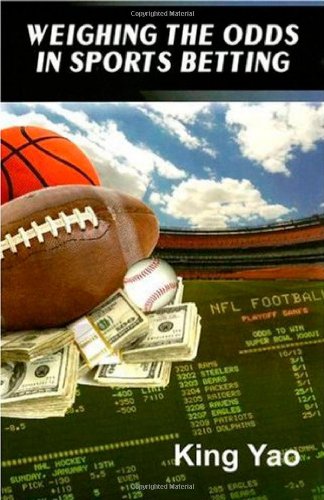
Weighing the Odds in Sports Betting
An options trader works through the arithmetic: implied chance, the hold, fair odds, hedging, middles and pricing a prop from a projection. The closest thing to a textbook for prop bettors.
Questions
Bet only where it's legal for you and only money you can afford to lose. If betting stops being fun, call or text the National Problem Gambling Helpline at 1-800-MY-RESET (1-800-697-3738), free and confidential.
Comments
No comments yet. Be the first to comment!
Leave a Comment